
SPF doesn’t completely stop tanning. Sunscreens primarily block UVB rays (which cause burning), but some UVA rays (which cause tanning) can still reach your skin. Even SPF 50 only blocks about 98% of UVB rays, leaving 2% to penetrate your skin. You’ll tan less with proper sunscreen use, but for maximum protection, you’ll need to reapply regularly, wear protective clothing, and limit sun exposure. Discover safer alternatives for achieving that sun-kissed glow without the damage.
Key Takeaways
- SPF primarily protects against UVB rays (which cause sunburn), not UVA rays that primarily cause tanning.
- Even high SPF sunscreens allow some UV rays to reach the skin, with SPF 30 letting through 3% of UVB rays.
- Tanning can still occur with sunscreen use if not applied properly or reapplied every two hours.
- Broad-spectrum sunscreens provide better protection against tanning as they block both UVA and UVB rays.
- No sunscreen completely prevents tanning, especially during extended sun exposure or when application is insufficient.
The Science Behind SPF and UV Protection
While you might think that applying sunscreen with high SPF will completely prevent tanning, the science tells a more nuanced story.
SPF primarily measures protection against UVB rays, which cause sunburn, but doesn’t fully account for UVA rays that stimulate melanin production and lead to tanning.
When you apply SPF 30 sunscreen, you’re blocking about 97% of UVB rays, while SPF 50 blocks approximately 98%. Neither provides complete protection.
For better defense against tanning and skin damage, look for broad-spectrum sunscreens that shield you from both UVA and UVB radiation.
Why You Still Tan While Wearing Sunscreen
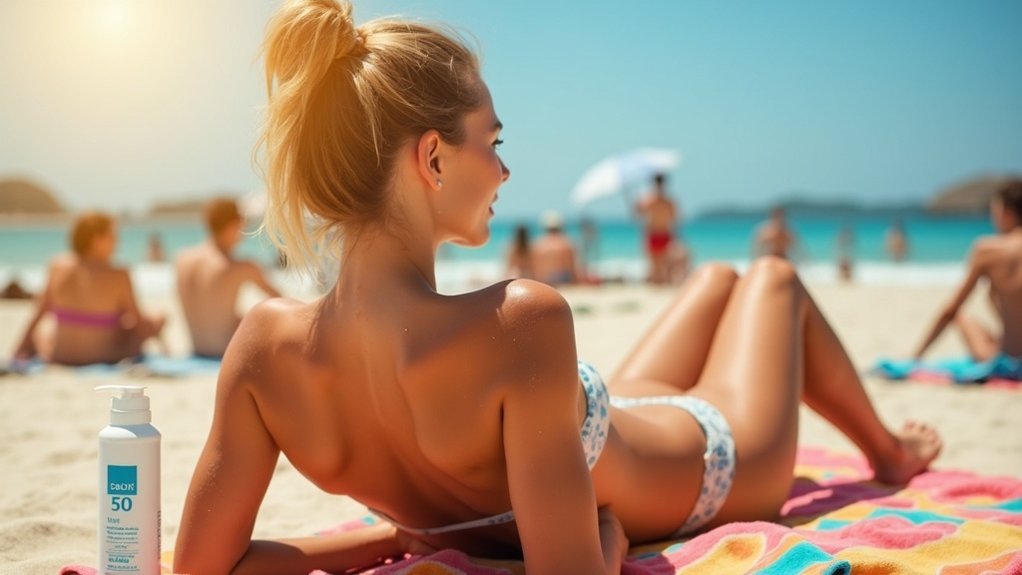
Despite your best efforts with sunscreen application, you’ll likely still develop some degree of tan during extended sun exposure.
This happens because even high SPF sunscreens don’t create an impenetrable shield against UV rays. An SPF 30 blocks about 97% of UVB rays, while SPF 50 blocks around 98% – meaning some rays still reach your skin and trigger melanin production.
UVA vs. UVB Rays: What’s Getting Through Your Sunscreen

How exactly do different ultraviolet rays affect your skin when you’re wearing sunscreen?
Your sunscreen’s SPF rating primarily measures protection against UVB rays, which cause sunburn and affect the outer epidermis.
However, UVA rays penetrate deeper into your skin and are mainly responsible for tanning.
Even when you apply SPF 30 sunscreen, about 3% of UVB rays still reach your skin.
More importantly, standard sunscreens don’t block all UVA rays, which stimulate melanin production.
That’s why you’ll still tan despite sunscreen use.
For better protection, choose broad-spectrum formulations designed to shield against both types of UV exposure.
How Different SPF Levels Affect Tanning
While SPF 30 blocks about 97% of UVB rays, you’ll still get some UV exposure that can lead to tanning, even with regular reapplication.
Higher protection levels like SPF 50 offer slightly better coverage, blocking around 98% of UVB rays, but they can’t completely prevent your skin from tanning during extended outdoor activities.
You’ll get the most comprehensive protection from broad-spectrum sunscreens that shield against both UVA and UVB rays, though tanning remains possible since no sunscreen creates a perfect barrier against all UV radiation.
Higher SPF, Less Tan
If you’ve ever wondered whether a higher SPF number actually makes a difference in your tan, the answer is yes—it definitely does.
Higher SPF sunscreens provide increased protection against UVB rays, with SPF 30 blocking about 97% and SPF 50 blocking approximately 98% of harmful rays that cause DNA damage and sunburn.
When you’re using broad-spectrum sunscreen with a higher sun protection factor, you’re significantly reducing your skin’s exposure to radiation that triggers tanning.
However, it’s important to understand that no sunscreen completely prevents tanning, as some UV rays still penetrate your skin.
Sunscreen effectiveness depends heavily on proper application—you need to apply enough and reapply every two hours.
Even with SPF 50, if you’re not applying correctly, you won’t get the full protection against skin damage.
SPF Protection Spectrum
Understanding the differences between SPF levels can help you make better choices for your skin’s protection.
While SPF 30 blocks about 97% of UVB rays (the ones causing sunburn), SPF 50 only increases that protection slightly to 98%.
Neither fully prevents tanning, as UVA rays—primarily responsible for tanning and skin aging—aren’t equally covered by the SPF rating.
For comprehensive protection, you’ll need broad-spectrum sunscreen that addresses both UVB and UVA radiation.
Remember that regardless of the SPF number, prolonged sun exposure will still lead to some tanning and potential skin damage.
The key to maximizing sunscreen effectiveness isn’t just choosing a higher number—it’s applying enough product and remembering to reapply every two hours, especially after swimming or sweating.
Common Sunscreen Application Mistakes That Lead to Tanning
Despite your best intentions with sunscreen, you’re likely making several common mistakes that compromise its effectiveness. Most people apply only half the recommended amount—you need a golf ball-sized portion for full-body coverage to prevent insufficient protection.
Even with SPF 30, you must reapply every two hours, especially after swimming or sweating.
Don’t overlook common missed spots like ears, backs of knees, and feet, which can lead to uneven tanning.
Remember that only broad-spectrum sunscreen protects against both UVA and UVB rays; without it, your skin remains vulnerable to UVA exposure that causes tanning and skin damage.
Timing matters too—applying sunscreen after you’re already in the sun won’t prevent damage that’s already occurring. Proper application is your best defense against unwanted UV exposure.
The Relationship Between Skin Type and Tanning With Sunscreen
Your skin type plays a crucial role in how you respond to sun exposure, even when you’re wearing sunscreen. According to dermatologists, the Fitzpatrick scale categorizes skin from type I (fair, burns easily) to type VI (dark, rarely burns), with each type having different tanning potential.
If you have fair skin (types I-II), you’ll burn more easily and require higher SPF protection, but may still tan gradually.
Those with darker skin (types III-VI) have more melanin, offering some natural UV protection, but you’re not immune to damage.
Remember that no sunscreen completely blocks all UV rays. Even with proper application, some rays penetrate your skin, potentially causing tanning.
For maximum protection, choose broad-spectrum SPF 30+ and reapply every two hours, regardless of your skin type.
Health Implications of Tanning Even With SPF
Even when you’re wearing sunscreen, your skin isn’t completely protected from the harmful effects of UV radiation, which can lead to serious long-term health consequences.
Your risk of developing skin cancer, including deadly melanoma, remains elevated any time your skin tans, regardless of whether you’ve applied SPF 30, 50, or higher.
The damage to your skin continues beneath the surface with each tanning session, accelerating premature aging through the breakdown of collagen and elastin, which can’t be reversed once it occurs.
Cancer Risk Remains
While sunscreen offers significant protection against UV rays, the cancer risk doesn’t disappear completely when you apply SPF before tanning.
Even with broad-spectrum sunscreen, approximately 3% of UVB rays penetrate your skin when using SPF 30, causing DNA damage and increasing melanoma risk over time.
The World Health Organization classifies UV radiation as a Group 1 carcinogen, meaning there’s no “safe” level of tanning. Your tanned skin is actually visible evidence of skin damage, regardless of how diligently you’ve applied sunscreen.
This matters because consistent UV exposure, even with SPF protection, can lead to photoaging, hyperpigmentation, and increased skin cancer risk.
Skin Damage Continues
Despite your best efforts with SPF application, skin damage processes don’t completely stop when you’re tanning.
Even broad-spectrum sunscreen with high SPF ratings only blocks about 97% of UVB rays, leaving your skin vulnerable to the remaining radiation.
More concerning, most sunscreens can’t fully shield you from UVA rays, which penetrate deeper into your skin layers.
When your skin darkens, it’s actually showing signs of damage through increased melanin production—your body’s defensive response to UV exposure.
This cellular reaction indicates DNA damage is occurring, regardless of your sunscreen use.
Over time, this continuous exposure contributes to premature aging, hyperpigmentation, and elevates your risk of skin cancer.
Safer Alternatives for Achieving a Bronzed Look
Looking for a sun-kissed glow without risking skin damage? Self-tanning lotions offer a beautiful tan appearance without harmful UV exposure.
These products contain dihydroxyacetone (DHA), which safely reacts with your skin’s outer layer to create a natural-looking bronze.
Spray tans provide another excellent option, developing over several hours for an even, sun-kissed look.
For temporary results, bronzers give you instant color that washes off at day’s end.
Best Practices for Minimizing Tanning While Protecting Your Skin
Self-tanning products offer a safer glow, but many people still find themselves exposed to the sun’s rays during daily activities. To minimize tanning, always apply broad-spectrum sunscreen with SPF 30 or higher, which blocks about 97% of harmful UV rays.
Remember to reapply every two hours, especially after swimming or sweating.
For maximum skin protection, wear UPF-rated clothing, wide-brimmed hats, and UV-blocking sunglasses when outdoors.
Limit sun exposure during peak hours (10 a.m. to 4 p.m.) when UV radiation is strongest.
Be aware of reflective surfaces like water and sand, which can bounce UV rays back onto your skin, increasing tanning risk even with sunscreen.