
Perfume longevity varies significantly by type: Eau de Parfum lasts 4-6 hours, Eau de Toilette 2-4 hours, and Eau de Cologne about 2 hours, while perfume oils can last 6-8 hours or longer. Your skin type matters too—fragrances last longer on oily skin than dry skin. Environmental factors like temperature and humidity affect wear time, with cooler conditions preserving your scent. Proper application to pulse points and appropriate storage away from heat and light can dramatically extend your fragrance’s performance.
Key Takeaways
- Eau de Parfum lasts 4-6 hours while perfume oils can last 6-8+ hours due to higher fragrance oil concentration.
- Skin type affects longevity, with fragrances lasting 8-12 hours on oily skin but only 2-4 hours on dry skin.
- Apply perfume to pulse points and moisturized skin for better projection and extended wear time.
- Environmental conditions impact fragrance duration, with cool temperatures and humidity improving longevity.
- Proper storage in cool, dark places away from humidity extends shelf life and maintains fragrance integrity.
Understanding the Shelf Life of Different Perfume Types
When you’re shopping for fragrances, understanding how long each type will last can help you make the best choice for your needs. Fragrance longevity varies significantly based on concentration levels.
Eau de Parfum (EDP) offers impressive staying power, lasting 4-6 hours with its 15-20% fragrance oil concentration. This makes it ideal for special occasions when you want to smell delightful all evening.
In contrast, Eau de Toilette stays with you for 2-4 hours, while Eau de Cologne provides a refreshing but brief 2-hour experience.
For maximum longevity, consider perfume oils. With 20-30% concentration, they can last 6-8 hours or more.
The Science Behind Fragrance Longevity
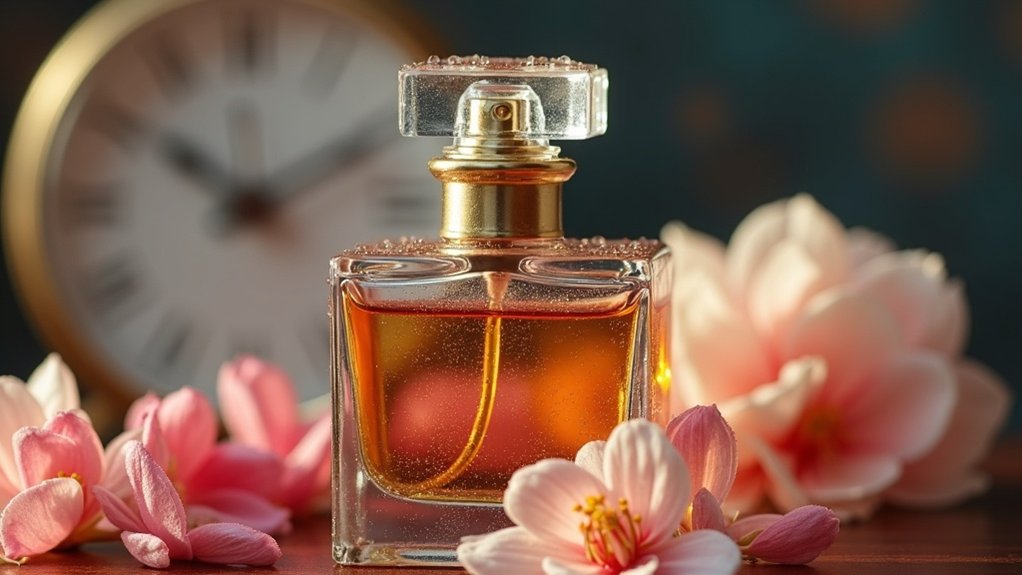
Although you might think perfumes evaporate randomly, there’s actually fascinating science behind how long your favorite scent lasts on your skin.
Fragrance longevity depends largely on the concentration of fragrance oils in your perfume—higher concentrations (20-30% in parfums) last significantly longer than lighter formulations like eau de toilette.
Your skin chemistry plays a crucial role too. If you have oily skin, you’ll enjoy fragrances for 8-12 hours, while those with dry skin might only experience 2-4 hours of scent.
The molecular structure matters as well; base notes like musk and amber have larger molecules that evaporate more slowly, extending your fragrance’s presence.
Environmental conditions affect your perfume too—cooler temperatures preserve scents longer, while heat accelerates evaporation.
Manufacturers add fixatives to slow this process down.
How Your Skin Type Affects Perfume Performance
Your skin type isn’t just important for skincare—it significantly impacts how perfume performs on your body.
If you have oily skin, you’re in luck! The natural oils help fragrances adhere better, extending longevity to 8-12 hours with proper application. Your scent will last longer throughout the day, requiring fewer reapplications.
Those with dry skin face more challenges, as fragrances may fade within 2-4 hours. Don’t worry—you can improve longevity by applying a fragrance-free moisturizer before your perfume. This creates a hydrated base that helps the scent cling to your skin more effectively.
Remember that your unique skin chemistry affects how fragrances develop over time.
For optimal results regardless of skin type, apply perfume to pulse points like wrists and neck, where body heat enhances diffusion.
Optimal Application Techniques for Lasting Scent
To make your perfume last all day, you’ll need to master a few simple application techniques that professionals use.
Strategically placing your favorite scent on pulse points, like your wrists and neck, helps the fragrance project better as your body’s natural warmth activates the scent molecules.
Applying a fragrance-free moisturizer before your perfume creates a hydrated base that helps the scent molecules cling to your skin longer, while extending your scent experience through layering with matching body products can create a fuller, more lasting impression.
Strategic Pulse Points
Mastering the art of perfume application involves understanding where and how to apply your fragrance for maximum impact. To achieve optimal fragrance diffusion, target your pulse points – areas where blood vessels are closest to the skin’s surface. These spots generate natural body heat that helps release and amplify your scent throughout the day.
Apply your perfume to traditional pulse points like wrists, neck, and behind ears, but don’t stop there. For enhanced projection, consider less obvious locations such as inner elbows and the back of knees. These moving areas create warmth as you go about your day, continually activating the fragrance.
Remember: spray from 6-8 inches away for even distribution, and never rub your wrists together afterward. This practice breaks down scent molecules, preventing your fragrance from staying longer on the skin.
Layering for Longevity
While many fragrance enthusiasts focus solely on finding the perfect scent, the true secret to all-day perfume presence lies in strategic layering techniques.
Begin with fragrance-free moisturizer on pulse points to create a foundation that helps perfume adhere better to your skin.
Next, apply a lighter concentration first, followed by a high concentration formula like eau de parfum or perfume oil. This approach creates depth and extends wear time significantly longer than single-application methods.
Don’t forget your clothing—fabrics retain fragrances better than skin, ensuring your signature scent lingers throughout the day.
Experiment with complementary scent families, such as pairing floral notes with woody undertones or citrus with spicy elements.
This personalized approach not only enhances longevity but allows you to create a unique fragrance identity that truly represents you.
Moisture Enhances Projection
Properly moisturized skin serves as the perfect canvas for your favorite fragrance, dramatically extending its lifespan throughout your day.
When you apply a fragrance-free moisturizer before your perfume, you’re creating an ideal foundation that can transform a fleeting scent into one that lasts 8-12 hours, compared to just 2-4 hours on dry skin.
For maximum fragrance diffusion, apply your perfume to pulse points like wrists and behind ears after moisturizing.
These strategic application areas combine with your body’s natural heat to amplify projection.
Remember not to rub your wrists together after applying perfume, as this breaks down the fragrance molecules.
Instead, allow the scent to settle naturally on your moisturized skin for optimal longevity and a more consistent scent experience.
Perfume Longevity on Clothing vs. Skin
Despite what you might assume, where you apply your perfume significantly impacts how long the scent will last. Your skin type plays a crucial role in fragrance longevity—oily skin can hold scents for 8-12 hours, while dry skin may retain them for only 2-4 hours.
Clothing, particularly natural fabrics like cotton and wool, offers superior longevity compared to skin, often extending your fragrance’s life to 24 hours or more.
When applying perfume to your clothes, stand 6-8 inches away and target areas that move, such as collars and cuffs, for better scent diffusion.
Unlike natural fabrics, synthetic materials like polyester don’t absorb fragrances as effectively.
Additionally, applying perfume to clothing helps avoid the rapid evaporation caused by your body heat, especially in warmer weather.
Climate and Environmental Effects on Fragrance Duration
Your perfume’s staying power changes dramatically depending on the weather conditions you’re in.
Humidity works against you by speeding up how quickly lighter notes evaporate, while the heavier base notes often stick around longer in moist air.
You’ll notice your favorite scents last much longer during cool weather, which is why many fragrance enthusiasts switch between seasonal perfume wardrobes.
Humidity’s Impact
While exploring the many factors affecting your perfume’s staying power, humidity stands out as a particularly influential element.
In humid environments, your fragrance longevity may actually improve as moist air helps retain scent molecules on your skin better than dry conditions. You’ll notice your perfume projects more strongly when humidity levels rise.
However, there’s a tradeoff to consider. Excessive humidity, especially when combined with high temperatures, can accelerate evaporation of lighter top notes and potentially alter your perfume’s intended scent profile.
Temperature fluctuations alongside humidity can further complicate how long your fragrance lasts throughout the day.
To help those you serve look and smell their best, suggest applying a fragrance-free moisturizer before perfume application. This simple step creates a hydrated base that enhances scent retention regardless of environmental conditions.
Weather Extremes Matter
Beyond humidity alone, weather extremes create dramatic shifts in how your perfume performs throughout the day.
When temperatures soar, your fragrance projects more strongly initially, but evaporation rates accelerate dramatically, causing lighter scents to fade faster than you’d expect. This means your carefully applied morning scent might disappear by lunchtime.
In contrast, cooler conditions significantly enhance longevity by slowing down the evaporation of volatile compounds.
You’ll notice your perfume develops more fully and lasts longer during cooler seasons. To maximize your fragrance’s staying power, apply it during cooler moments of the day and on pulse points where it can gradually warm and release.
Be mindful that extreme temperature fluctuations can actually alter your perfume’s chemical composition, changing how it smells and potentially reducing its shelf life.
Identifying Signs of Expired Perfume
Everyone eventually faces the challenge of determining whether a beloved fragrance has passed its prime.
To identify expired perfume, trust your nose first—oxidation often transforms pleasant scents into metallic, sour, or vinegar-like odors. Visual inspection matters too; look for color changes toward darker hues or cloudiness, which signal fragrance quality deterioration.
Pay attention to texture changes as well. If your once-fluid perfume becomes sticky or unusually thick, it’s likely past its prime.
Your familiarity with the original scent plays a crucial role in identifying signs of expiration, so trust your memory when something seems “off.”
If you’re still unsure, conduct a small patch test on your skin. Expired fragrances may cause irritation that fresh ones wouldn’t—your skin’s reaction can provide the final confirmation.
Storage Solutions to Maximize Perfume Life
Proper storage makes all the difference between a fragrance that remains vibrant for years and one that deteriorates within months. Your perfume’s longevity depends significantly on storage conditions, so find a cool, dark location away from direct sunlight and humidity.
Keep your opened bottle tightly sealed when not in use to prevent oxygen exposure, which causes scent degradation.
Don’t discard that original box! It provides valuable protection against light damage and temperature fluctuations.
Avoid storing your fragrances in bathrooms where humidity and temperature changes accelerate deterioration. Instead, consider a dresser drawer, closet shelf, or dedicated perfume cabinet.
With proper care, your favorite scents can maintain their intended character for much longer.
Regularly check your collection for any signs of color change or altered smell to ensure optimal freshness.
Extending Wear Time With Fragrance Layering
Fragrance layering isn’t just a luxury ritual—it’s your secret weapon for making perfumes last substantially longer throughout the day.
You’ll maximize longevity when you start with scented lotions or oils as a base layer, creating a foundation that helps your fragrance cling to your skin more effectively.
For best results, experiment with complementary scent families, such as pairing a vanilla-based lotion with a woody perfume or a citrus body wash with a floral spray, creating a complex, multi-dimensional aroma that evolves beautifully over time.
Fragrance Layering Techniques
When you’re looking to make your favorite scent last throughout the day, mastering the art of fragrance layering can be a game-changer.
Begin with a fragrance-free moisturizer on clean skin, creating the perfect base for your scents to adhere to and improving overall longevity.
Apply your lighter fragrances first, focusing on pulse points like wrists, neck, and behind the ears, where body heat naturally amplifies scent projection.
Follow with your stronger perfume to create complexity and depth. For maximum scent endurance, consider using products from the same fragrance family—shower gels, lotions, and oils work together to reinforce your signature scent.
Don’t forget to pack a travel-sized version of your perfume for touch-ups throughout the day, ensuring your carefully layered fragrance continues to serve you well from morning to evening.
Matching Complementary Scents
Building on the layering techniques we’ve explored, selecting truly complementary scents forms the foundation of extended fragrance longevity.
When helping others enhance their scent experience, focus on pairing fragrances from similar families – florals with florals or woody notes with other woody compositions – to create harmonious combinations that last longer on skin.
For maximum scent longevity, start with a fragrance-free moisturizer as your base, then layer your complementary scents.
Try combining different formulations from your fragrance collection, such as an eau de parfum with a matching perfume oil, to benefit from the oil’s higher concentration.
You’ll notice enhanced staying power when you apply a light mist to both skin and clothing, as fabrics retain fragrances longer than skin.
These strategic fragrance layering techniques help those you serve enjoy their favorite scents throughout the day.
Seasonal Strategies for All-Day Scent Projection
How you adapt your perfume routine throughout the year can dramatically impact its longevity and projection.
To ensure your Long Perfume Lasts in warmer weather, select fragrances with lighter top notes like Eau de Toilette, which won’t become overpowering as temperatures rise.
For colder months, embrace heavier base notes such as amber or musk, which evaporate more slowly and provide extended scent presence.
Always apply perfume to pulse points in cool weather for optimal diffusion, letting your body’s natural warmth activate the fragrance.
During humidity, try spraying fragrance directly onto clothing instead of skin, as fabric retains scent longer.
For any season, layering an unscented moisturizer underneath your perfume creates a hydrated base that helps lock in the scent throughout the day.